Es mostren els missatges amb l'etiqueta de comentaris 60s. Mostrar tots els missatges

dijous, 7 de juny del 2018

Últimas tardes con Teresa de Juan Marsé (1966)


EL MONTE CARMELO ES UNA COLINA DESNUDA y árida situada al noroeste de la ciudad. Manejados los invisibles hilos por expertas manos de niño, a menudo se ven cometas de brillantes colores en el azul del cielo, estremecidas por el viento, asomando por encima de la cumbre igual que escudos que anunciara n un sueño guerrero. En los grises años de la postguerra, cuando el estómago vacío y e l piojo verde exigían cada día algún sueño que hiciera más soportable la realidad, el Mo nte Carmelo fue predilecto y fabuloso campo de aventuras de los desarrapados niños de los barrios de Casa Baró, del Guinardó y de La Salud. Subían a lo alto, donde silba el vient o, a lanzar cometas de tosca fabricación casera, hechas con pasta de harina, cañas, trapos y papel de periódico: durante mucho tiempo temblaron, coletearon furiosamente en el cie lo de la ciudad, fotografías y noticias del avance alemán en los frentes de Europa, reinaba la muerte y la desolación, el racionamiento semanal de los españoles, la miseria y el hambre
[...]

Quién sabe si al ver llegar a los r efugiados de los años cuarenta, jadeando como náufragos, quemada la piel no sólo por el sol despiadado de una guerra perdida, sino también por toda una vida de fracasos, tuvieron al fin conciencia del naufragio nacional, de la isla inundada para siempre, del paraíso perdido que este Monte Carmelo iba a ser en los años inmediatos
[...]

Y son los mismos pensamientos, la misma impaciencia de entonc es la que invade hoy los gestos y las miradas de los jóvenes del Carmelo al contemplar la ciudad desde lo alto, y en consecuencia los mismos sueños, no nacidos aquí, si no que ya viajaron con ellos, o en la entraña de sus padres emigrantes. Impaciencias y su eños que todas las madrugadas se deslizan de nuevo ladera abajo, rodando por encima de las azoteas de la ciudad que se despereza, hacia las luces y los edificios que emer gen entre nieblas. Indolentes ojos negros todavía no vencidos, con los párpados entornados, r ecelosos, consideran con desconfianza el inmenso lecho de brumas azulinas y las luces que diariamente prometen, vistas desde arriba, una acogida vagamente nupcial, una sensació n realmente física de unión con la esperanza. En las luminosas mañanas del verano, cua ndo las pandillas de niños se descuelgan en racimos por las laderas y levantan el polvo con sus pies, el Monte Carmelo es como una pantalla de luz.

http://smaris.edu.ec/wp-content/uploads/2017/03/Marse-Juan-Ultimas-Tardes-Con-Teresa-3ro-BI.pdf

dilluns, 23 de desembre del 2013

Slaughterhouse 5 de Kurt Vonnegut (1969)

I looked through the Gideon Bible in my motel room for tales of great destruction. The sun was risen upon the Earth when Lot entered into Zoar, I read. Then the Lord rained upon Sodom and upon Gomorrah brimstone and fire from the Lord out of Heaven; and He overthrew those cities, and all the plain, and all the inhabitants of the cities, and that which grew upon the ground.
So it goes.
Those were vile people in both those cities, as is well known. The world was better off without them.
And Lot's wife, of course, was told not to look back where all those people and their homes had been. But she did look back, and I love her for that, because it was so human.
She was turned to a pillar of salt. So it goes.
People aren't supposed to look back. I'm certainly not going to do it anymore.
I've finished my war book now. The next one I write is going to be fun.
This one is a failure, and had to be, since it was written by a pillar of salt. It begins like this:
Listen:
Billy Pilgrim has come unstuck in time. (pàg. 16)

Roland Weary was only eighteen, was at the end of an unhappy childhood spent
mostly in Pittsburgh, Pennsylvania. He had been unpopular in Pittsburgh. He had been unpopular because he was stupid and fat and mean, and smelled like bacon no matter how much he washed. He was always being ditched in Pittsburgh by people who did not want him with them.
It made Weary sick to be ditched. When Weary was ditched, le would find somebody
who was even more unpopular than himself, and he would horse around with that person for a while, pretending to be friendly. And then he would find some pretext for beating the shit out of him. (pàg. 25)

Like so many Americans, she was trying to construct a life that made sense from things she found in gift shops. (pàg. 28)

Billy was extrapolating. Everybody turned into a baby, and all humanity, without exception, conspired biologically to produce two perfect people named Adam and Eve, he supposed. (pàg. 54)

'Welcome aboard, Mr. Pilgrim,' said the loudspeaker. 'Any questions?'
Billy licked his lips, thought a while, inquired at last: 'Why me? '
That is a very Earthling question to ask, Mr. Pilgrim. Why you? Why us for that matter? Why anything? Because this moment simply is. Have you ever seen bugs trapped in amber?'
'Yes.' Billy in fact, had a paperweight in his office which was a blob of polished amber with three ladybugs embedded in it.
'Well, here we are, Mr. Pilgrim, trapped in the amber of this moment. There is no why.' (pàg. 55)

It wasn't safe to come out of the shelter until noon the next day. When the Americans and their guards did come out, the sky was black with smoke. The sun was an angry little pinhead. Dresden was like the moon now nothing but minerals. The stones were hot. Everybody else in the neighborhood was dead. So it goes. (pàg. 129) 

Rumfoord ordered her to sit down and read the Truman statement now. He didn't know that she couldn't read much. He knew very little about her, except that she was one more public demonstration that he was a superman. (pàg. 135)


divendres, 2 d’agost del 2013

Stoner de John Williams (1965)

"It is a sonnet, Mr. Stoner," Sloane said dryly, "a poetical composition of fourteen lines, with a certain pattern I am sure you have memorized. It is written in the English language, which I believe you have been speaking for some years. Its author is William Shakespeare, a poet who is dead, but who nevertheless occupies a position of some importance in the minds of a few. (...)
Mr. Shakespeare speaks to you across three hundred years, Mr. Stoner; do you hear him?" (pàg.12)

"Sometimes, in the evenings, he wandered in the long open quadrangle, among couples who strolled together and murmured softly; though he did not know any of them, and though he did not speak to them, he felt a kinship with them. Sometimes he stood in the center of the quad, looking at the five huge columns in front of Jesse Hall that thrust upward into the night out of the cool grass(...) Grayish silver in the moonlight, bare and pure, they seemed to him to represent the way of life he had embraced, as a temple represents a god" (pàg. 15)

"It's for us that the University exists, for the dispossessed of the world; not for the students, not for the selfless pursuit of knowledge, not for any of the reasons that you hear. We give out the reasons, and we let a few of the ordinary ones in, those that would do in the world;" (pàg. 31)

"Like many men who consider their success incomplete, he was extraordinarily vain and consumed with a sense of his own importance. Every ten or fifteen minutes he removed a large gold watch from his vest pocket, looked at it, and nodded to himself" (pàg. 58)

 "As he worked on the room, and as it began slowly to take a shape, he realized that for many years, unknown to himself, he had had an image locked somewhere within him like a shamed secret, an image that was ostensibly of a place but which was actually of himself. So it was himself that he was attempting to define as he worked on his study" (pàg. 100)

"He found himself trembling; as awkwardly as a boy he went around the coffee table and sat beside her. Tentatively, clumsily, their hands went out to each other; they clasped each other in an awkward, strained embrace; and for a long time they sat together without moving, as if any movement might let escape from them the strange and terrible thing that they held between them in a single grasp." (pàg. 193)

dimarts, 6 de novembre del 2012

La plaça del diamant de Mercè Rodoreda (1962)

"Explicar la gènesi de La plaça del Diamant potser seria interessant, però ¿és que es pot explicar com es forma una novel·la, quins impulsos la provoquen, quina voluntat tan forta aconsegueix que es continuï, que s'hagi d'acabar amb lluita el que s'ha començat fàcilment? ¿Dir que la vaig anar rumiant a Ginebra tot mirant la muntanya del Salève o tot passejant per La Perla de LLac, bastaria? […] La vaig escriure febrosament, com si cada dia de treball fos el darrer de la meva vida. Treballava encegada; corregia a la tarda el que havia escrit al matí, procurant que, malgrat les presses amb què escrivia, el cavall no se'm desboqués, aguantant bé les regnes perquè no es desviés del camí. […] fou una època d'una gran tensió nerviosa, que em va deixar mig malalta"

dilluns, 29 d’octubre del 2012

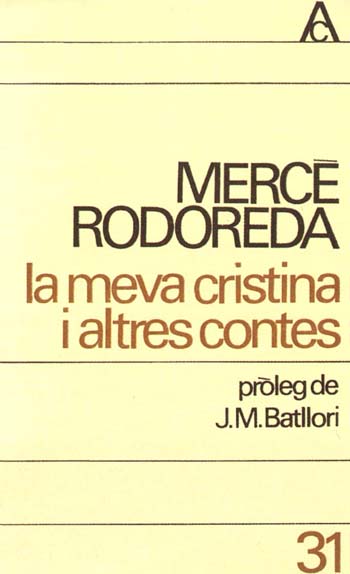
La meva Cristina i altres contes de Mercè Rodoreda (1967)

La meva Cristina i altres contes va constituir, a la seva publicació l'any 1967, un dels èxits més assenyalats de la carrera literària de Mercè Rodoreda. En principi, cap de les narracions que inclou no explica una història travada, amb un argument plantejat segons les normes clàssiques del gènere, sinó que es limiten a descriure gairebé ingènuament una situació, mig evocativa.

   
Quin mal vol que facin amb el cap de porcellana o de cartó, els ossos de ferro colat, les cames de fusta i el ventre ple de serradures...”. I les paraules l'escanyaven. La sala de les nines

dimecres, 10 d’octubre del 2012

Pugeu la biga mestra, fusters i Seymour, una introducció de J. D. Salinger (1963)

Raise high the roof beam, carpenters (Pugeu la biga mestra, fusters, 1955; traducció catalana d'Antoni Pigrau), (Seymour: an introduction 1963; traducció catalana de Manuel de Pedrolo). Ambdues s'ambienten al voltant de Seymour i la seva família, que s'inicia amb el magistral relat del seu casament i culmina amb l'auto-descripció de la seva destrucció

dilluns, 6 d’agost del 2012

Carta al pare de Franz Kafka (1966)

Kafka escrigué Carta al pare quan tenia 36 anys, provocada per el trencament del seu prometatge (el tercer!) amb una jove, filla d'un servent de sinagoga. Tot i que el pare ja s'havia mostrat al contrari a aquest matrimoni, Kafka sent la necessitat de justificar-se. Constitueix, de fet, un esbós d'autobiografia i un nou intent de salvar-se en la literatura. Kafka acusa el seu pare dels seus mals i reconstrueix la història de llur convivència sense callar anècdotes cruels ni estalviar-se explicacions humiliants amb un estil minuciós, cortès, exhaustiu. Cada plany, cada confessió o cada retret semblen excessius i tot plegat sembla desorbitat, sense que s'arribi a un judici definitiu, cosa que fa pensar que malgrat la confrontació personal, Kafka se les heu amb un enemic impersonal, tot allò que no és ell, el món, el defora o el curs de la vida. Franz Kafka (Praga, 1883 - Viena, 1924). Fou un escriptor txec en llengua alemanya. La seva obra és una de les més influents de la literatura universal de l'últim segle, malgrat que no és gaire extensa: va ser autor de tres novel·les (El procés, El castell i Amèrica), una novel·la curta, La metamorfosi, i un cert nombre de paràboles i relats breus. A més, va deixar una abundant correspondència i escrits autobiogràfics, la major part publicats pòstumament.